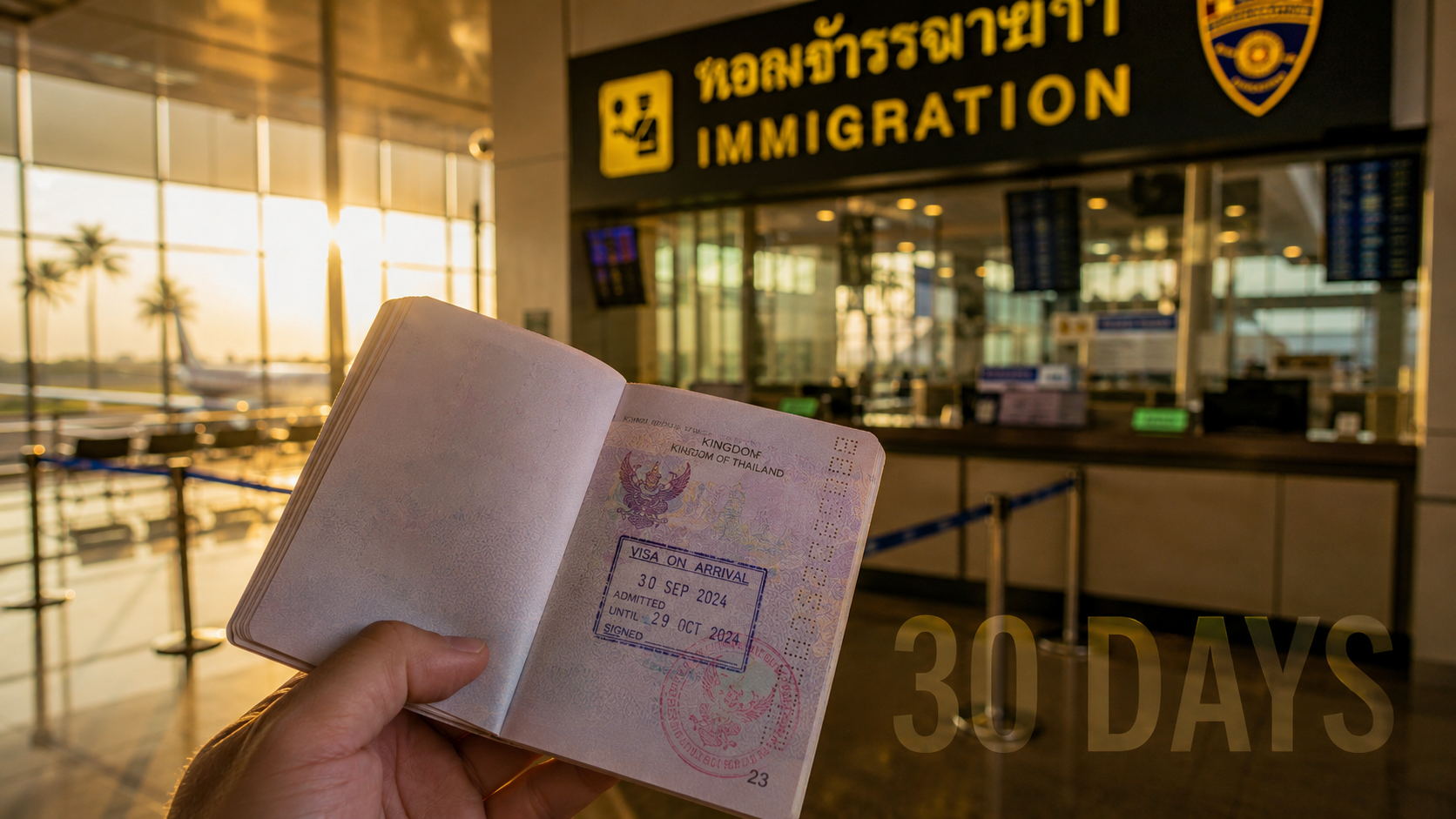
The date is now confirmed: the new rules take effect on 15 September 2026. The Ministry of Interior announcements were published in the Royal Gazette on 31 August and the Tourism Authority of Thailand confirmed the timing on 1 September.
Thailand’s Cabinet revoked the 60-day visa exemption on 19 May 2026, and this is when the replacement starts. Visa-free entry drops to 30 days, and the number of eligible countries falls from 93 to 60. Entries up to and including 14 September still get the old allowance.
This guide breaks down what happened, who is affected, and what your options are if you want to stay longer.
What Changed
The 60-day visa exemption was introduced in 2024 to boost tourism after the pandemic slowdown. It applied to 93 countries and was meant to make Thailand more competitive with destinations like Vietnam and Indonesia.
The Thai government has now reversed that decision. The main reasons cited by officials are security concerns — the extended visa-free window was being exploited by people entering as tourists but engaging in illegal work, online scam operations, and other criminal activity.
Government data shows the average foreign tourist stays in Thailand for roughly nine days, well below the 60-day limit. The generous exemption was mostly benefiting people who were not traditional tourists.
The New Visa Structure
Thailand is moving to a tiered system:
30-day visa exemption — 60 countries and territories, down from 93. This still covers Thailand’s main tourism markets: the United States, United Kingdom, Germany, France, Australia, Canada, Switzerland and most EU member states.
15-day exemption — Seychelles and Mauritius.
Visa on Arrival — Azerbaijan, Belarus and Serbia move into this category under the updated framework.
90-day bilateral exemption — maintained for Argentina, Brazil, Chile, Peru and South Korea.
The cut from 93 eligible countries to 60 is the part that gets less attention than the day count, and it matters more: 33 nationalities lose visa-free access entirely and now need a visa before travelling. If your passport is not from a major Western market, check the current list before you book anything.
Still on the list: all 27 EU member states, the UK, the United States, Canada, Australia, New Zealand, Japan, Switzerland and India.
Two changes almost nobody mentions
The new exemption is for tourism only. The outgoing 60-day rule also covered short business visits. From 15 September it does not — if you are coming for meetings, a conference or anything that reads as business at the desk, the visa-free route no longer covers you.
Land border entries are capped at two per calendar year under the new exemption. Arriving by air is not limited. This ends the old border-run rhythm for anyone who was living on repeated overland entries.
When Does This Take Effect?
15 September 2026. The Royal Gazette publication happened on 31 August, and the Tourism Authority of Thailand confirmed the date on 1 September.
Arrivals up to and including 14 September are processed under the old rules and get the 60-day allowance. From the 15th, it is 30 days.
If you are already in Thailand on a 60-day visa-free entry when the change lands, that entry is not shortened retroactively — but do not rely on our reading of that. Confirm it at Pattaya Immigration if your dates are tight.
What This Means for Pattaya Visitors
For most Western tourists visiting Pattaya for a week or two, nothing changes in practice. Thirty days is more than enough for a holiday. The average tourist stay is well under two weeks.
The change primarily affects:
- Long-stay tourists who were using the 60-day window to avoid visa applications entirely
- Digital nomads working remotely from Pattaya on tourist entries
- Retirees and expats doing visa runs every 60 days instead of getting a proper long-term visa
If you fall into any of these categories, it is time to look at proper visa options rather than relying on visa-free entries.
How to Stay Longer Than 30 Days
30-day extension at immigration — after entering Thailand visa-free, you can visit a Thai Immigration office and apply for a 30-day extension. This costs 1,900 THB and is usually processed the same day. In Pattaya, the immigration office is located in Jomtien (Soi 5). This gives you a total of 60 days.
Tourist visa (TR) — apply at a Thai embassy or consulate before your trip. A single-entry tourist visa gives you 60 days, extendable by another 30 days at immigration for a total of 90 days. A multiple-entry tourist visa (METV) allows multiple 60-day entries over six months.
Education visa (ED) — if you want to learn Thai or Muay Thai in Pattaya, an ED visa allows stays of up to one year with regular reporting. Several language schools in Pattaya facilitate the process.
Thailand Digital Nomad Visa (DTV) — introduced in 2024 for remote workers. Valid for 180 days and extendable. You need to prove remote employment or freelance income. This is the most relevant option for digital nomads who were relying on tourist entries.
Retirement visa (O-A) — available if you are 50 or older and can meet financial requirements (800,000 THB in a Thai bank account or a monthly income of 65,000 THB). Grants a one-year stay.
Elite visa — Thailand’s premium long-stay visa program. Starts at around 600,000 THB for five years. No age or income requirements. Includes airport fast-track and other perks.
Pattaya Immigration Office
If you need a 30-day extension, the Pattaya Immigration Office is your destination:
Address: Soi 5, Jomtien Beach Road, Pattaya
What to bring:
- Passport with at least 6 months validity
- TM.6 departure card (if you still have it)
- One passport photo (4x6 cm)
- 1,900 THB in cash
- Completed TM.7 application form (available at the office)
Arrive early — the office can get crowded, especially during high season. Processing usually takes one to three hours.
Should You Worry?
If you are visiting Pattaya for a holiday, no. Thirty days is plenty for any vacation. The change mostly affects people who were stretching tourist entries beyond their intended purpose.
If you are planning to live in Pattaya long-term, this is a signal to get your visa situation sorted properly. The era of endless visa-free entries and border runs is coming to an end — Thailand is tightening enforcement across the board.
Plan ahead, apply for the right visa before you travel, and you will have zero problems.
Related Guides
- Pattaya Visa Guide
- Thailand Visa for Indian Passports — India keeps visa-free entry, with a shorter stay — every visa type, the immigration office, extensions and TM30
- Working Remotely from Pattaya — the five-year DTV for remote workers
- Muay Thai in Pattaya — the DTV via soft power activities
Pattaya.love Editorial Team
Local Experts since 2019
Our team of Pattaya-based writers, photographers, and long-term residents researches every guide on the ground. We visit venues, test routes, and verify every recommendation so you get actionable, up-to-date information you can trust.