More and more visitors and expats in Pattaya hold their money in crypto rather than traditional bank accounts. Whether you are a digital nomad paid in USDT, a long-term traveler who stores value in Bitcoin, or simply someone who wants to avoid international bank transfer fees, converting cryptocurrency to Thai Baht cash is straightforward in Pattaya — if you know where to go.
This guide covers the practical options for turning your crypto into spendable Baht, from walk-in OTC exchanges to online platforms and Bitcoin ATMs.
OTC Exchange Offices in Pattaya
OTC (over-the-counter) exchange offices are the most popular method for converting larger amounts of crypto to cash in Pattaya. These are physical offices where you send your crypto and receive Thai Baht in hand. The process is surprisingly simple.
How It Works — Step by Step
-
Contact the exchange via Telegram or WhatsApp. Tell them how much you want to exchange and in which cryptocurrency (USDT, BTC, or ETH). They respond within a few minutes with the current rate.
-
Agree on the rate. Rates are quoted live and locked in for a short window. The spread (their fee) is typically 3 to 4 percent compared to the market rate. Larger amounts often get better rates — ask.
-
Send your crypto. The exchange provides a wallet address in the chat. Send your USDT, Bitcoin, or Ethereum to that address. Wait for confirmation.
-
Visit the office. Walk in with your passport (required by Thai law for all exchange transactions). Show the Telegram conversation confirming your transfer. The staff will verify the transaction on the blockchain.
-
Receive your Baht. Once confirmed, you receive your Thai Baht in cash. The entire in-office process usually takes 10 to 20 minutes.
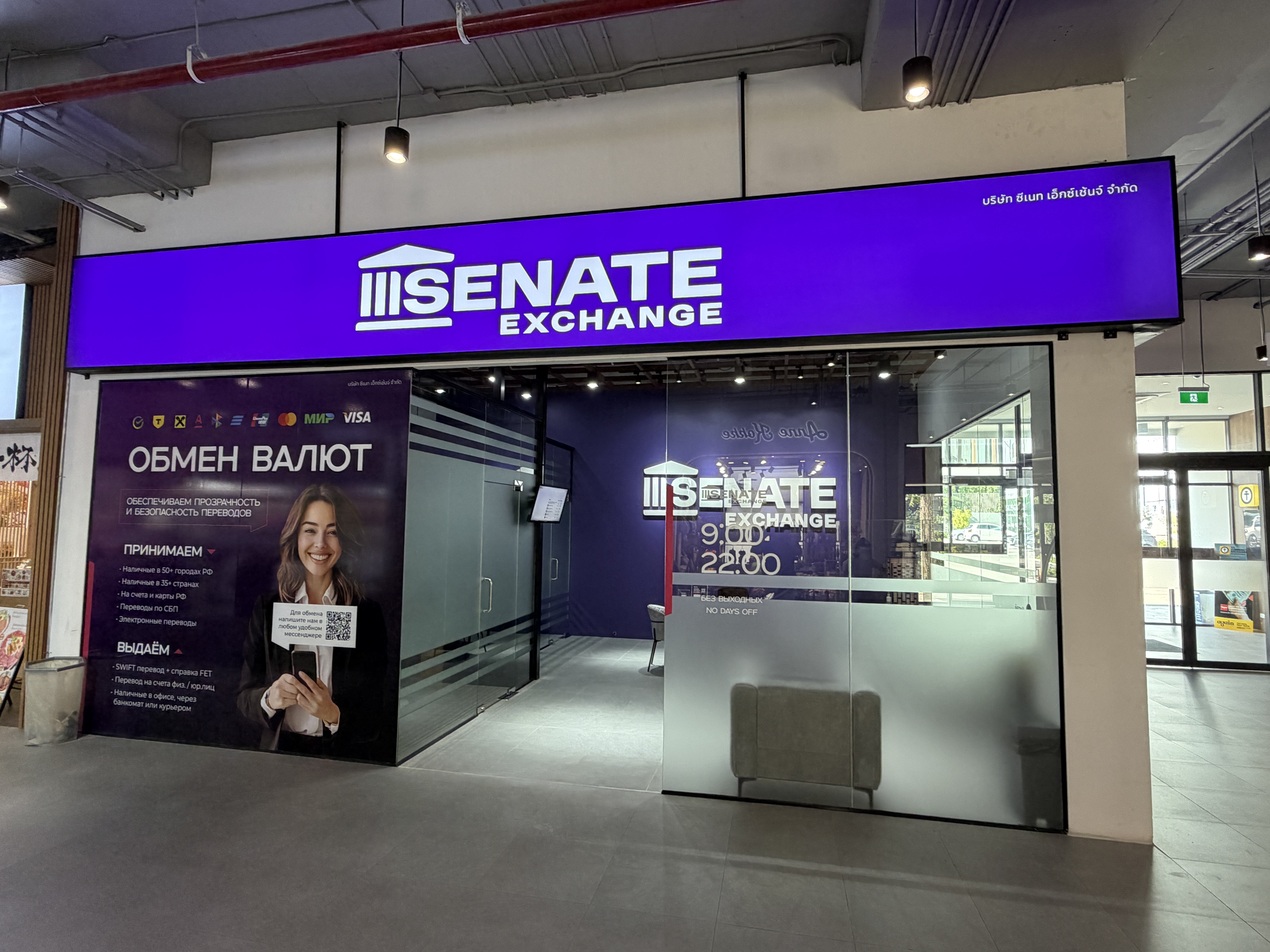
Senate Exchange
One of the established crypto-to-cash services operating in Pattaya since 2016, licensed by the Bank of Thailand.
Details:
- Locations in Pattaya: Multiple branches — main office on Thappraya Road (162, 157 Thappraya Rd), plus exchange points in Pratumnak and near the Ambassador area. Contact them via Telegram for the nearest location.
- Telegram: @SenateExchange_bot
- Phone / WhatsApp: +66 63 550 3442
- Crypto accepted: USDT, Bitcoin (BTC), Ethereum (ETH)
- Payout: Cash (THB, USD, EUR), bank transfer, or courier delivery
- Opening hours: 9:00 to 22:00 daily
- Requirements: Passport or driver’s license
- License: Bank of Thailand MC125660019
We have used Senate Exchange multiple times and the process is smooth. Everything is arranged via Telegram beforehand — you agree on the rate, send your crypto, and then walk into the store with your passport. The entire pickup takes just a few minutes once your transfer is confirmed.
Senate Exchange also has offices in Bangkok, Phuket, and Patong. In addition to crypto, they handle traditional currency exchange (USD, EUR, RUB, and more) and accept card payments via Visa, Mastercard, and UnionPay.
Their additional service options include cash delivery to your hotel or condo (courier brings the Baht to you) and direct bank transfers to Thai bank accounts.
Other OTC Services
Several other OTC crypto exchange services operate in Pattaya. They follow a similar process — contact via Telegram, send crypto, pick up cash. Always verify that the service holds a valid Thai license before sending any funds. Check recent reviews and start with a smaller test transaction if it is your first time using a new service.
Online Exchanges with Thai Baht Withdrawal
If you prefer a fully digital process, Thai-licensed cryptocurrency exchanges allow you to sell crypto and withdraw Baht to a Thai bank account.
Bitkub
Thailand’s largest crypto exchange, licensed by the Ministry of Finance and regulated by the SEC. You can sell Bitcoin, USDT, Ethereum, and other coins for Thai Baht and withdraw directly to a Thai bank account.
Pros: Regulated, transparent fees, large trading volume, competitive rates. Cons: Requires a Thai bank account for withdrawals. KYC verification takes time. Not instant cash — withdrawal to your bank takes a few hours.
Coins.co.th
Another SEC-licensed Thai exchange supporting USDT and Bitcoin trading with Thai Baht. They also offer OTC trading for larger amounts.
Pros: Licensed, supports OTC for big transactions. Cons: Same limitation — you need a Thai bank account.
Bitcoin ATMs
There is at least one Bitcoin ATM operating in Pattaya that allows selling Bitcoin for cash. However, Bitcoin ATMs are generally the worst option for conversion:
- Fees are high — typically 5 to 10 percent, far more than OTC offices.
- Limits are low — usually capped at small amounts per transaction.
- Availability is unreliable — machines sometimes run out of cash or go offline.
Use a Bitcoin ATM only as a last resort for small, urgent conversions.
Crypto Cards: Spending USDT Without Cashing Out
Every method above ends with a stack of Baht in your hand. But a growing share of what you pay for in Pattaya never needs cash: the hotel, Grab rides and Grab Food, Terminal 21 and Central Festival, Big C and Foodland, flights, the gym, the 7-Eleven. For all of that, a crypto-funded Visa skips the exchange step entirely. You top up in USDT, tap with Apple Pay or Google Pay, and the card settles the bill in Baht.
Karta
Karta issues a virtual Visa Signature funded from a USDT balance. There is no website login in the usual sense — the whole thing runs inside a Telegram bot. You start the bot, complete KYC (passport and a selfie; Karta says around five minutes), pay the card fee from your first top-up, and the virtual card is live. Add it to Apple Pay or Google Pay and it works at any contactless terminal in Thailand that takes Visa.
Fees (September 2026):
| Operation | Fee |
|---|---|
| Virtual card issuance | 5 USDT (list price 30 USDT, discounted at the time of writing) |
| Card replacement | 15 USDT |
| Top-up via Polygon, Solana, Base, Arbitrum, BSC, Optimism, Ethereum | Free |
| Top-up via TRC-20 (Tron) | 5.90 USDT |
| Card payment in THB (currency conversion) | 1.50% |
| ATM withdrawal | 2.50% + 1 USDT, plus the Thai bank’s ATM operator fee |
| Declined ATM attempt | 1 USDT |
| ATM limit | 250 USDT per withdrawal including the ATM fee, 3 attempts per rolling 24 hours |
| Per-transaction limit | 25,000 USDT |
Where it beats the OTC office. Card payments cost 1.5 percent. The OTC spread is 3 to 4 percent. Anything you can pay by card is cheaper on the card, and you skip the trip to Thappraya Road.
Where it loses. Cash. An ATM withdrawal costs 2.5 percent plus 1 USDT on Karta’s side, and then the Thai bank adds its usual foreign-card fee of 220 THB at most banks. On a maximum 250 USDT withdrawal that is roughly 7 USDT to Karta and another 6 to 7 USDT to the ATM, so around 5 to 6 percent all in — Bitcoin ATM territory, not OTC territory. The 250 USDT cap and the three-attempts rule also mean you cannot pull a serious amount of cash in a day. If you need Baht in hand, the OTC office still wins clearly.
The practical split: card for anything with a terminal, OTC for cash. Used that way, the card does not replace the exchange office — it cuts down how often you need it.
The network trap. Earlier in this guide we recommend TRC-20 as the cheapest way to send USDT to an OTC office. For Karta it is the opposite: TRC-20 top-ups cost 5.90 USDT, while Polygon, Solana, Base and the other listed networks are free. Check which network your exchange or wallet supports before you withdraw to the card.
Things to know before you sign up:
- It is a foreign-issued Visa, so Thai merchants treat it like any other overseas card. When the terminal asks whether to charge in USD or THB, always choose THB — dynamic currency conversion adds 3 to 5 percent on top of Karta’s 1.5 percent.
- Cash and PromptPay are still the default at markets, street food, small bars and motorbike rentals. The card covers the big-ticket, card-friendly half of your spending, not all of it.
- Karta is not a Thai-licensed exchange. The cards are issued through regulated card-issuing partners abroad. The same rule applies as with any new service: put a small amount on it first and see it work before you move real money.
- ATM withdrawals in practice need the physical card. The virtual card lives in Apple Pay or Google Pay, and NFC cash withdrawal is still rare at Thai ATMs. The physical card is currently on pre-order — 99 USDT for the plastic version, 299 USDT for a limited stainless-steel edition — with delivery slated for the third quarter of 2026. Unless you specifically want ATM access on this card, the virtual one is all you need.
Fees Compared
| Method | Typical Fee | Speed | Minimum |
|---|---|---|---|
| OTC Exchange (in person) | 3–4% | 10–20 min | None |
| OTC with delivery | 3–4% + delivery fee | 1–3 hours | Varies |
| Bitkub / Coins.co.th | ~0.25% trading + withdrawal | Hours | KYC required |
| Bitcoin ATM | 5–10% | Instant | Low limits |
| Crypto card (Karta) — card payment | 1.5% | Instant | 5 USDT card fee, KYC |
| Crypto card (Karta) — ATM cash | 2.5% + 1 USDT + ATM fee (~5–6% all in) | Instant | 250 USDT cap per withdrawal |
The online exchanges look cheaper on paper, but they require a Thai bank account and KYC verification — not practical for short-term visitors. For tourists and people without a Thai bank account, OTC offices are the most practical choice for cash despite the higher spread. For the part of your spending that goes through a card terminal, a crypto card is the cheapest route of all.
Important Considerations
Bring your passport. Thai anti-money laundering regulations require identification for all exchange transactions. No passport, no exchange — no exceptions.
Start small. If you are using an OTC service for the first time, exchange a smaller amount first to verify the process before sending larger sums. A test transaction of 10,000 to 20,000 THB equivalent lets you verify the service without significant risk.
Check the rate before you go. Compare the quoted rate to the live market rate on CoinGecko or CoinMarketCap. A 3 to 4 percent spread is normal and fair for an OTC cash service. Anything above 5 percent means you should look elsewhere.
Network fees matter. When sending crypto, choose the cheapest network. For USDT, TRC-20 (Tron) is usually the cheapest at under 1 USD per transaction. ERC-20 (Ethereum) can cost 5 to 20 USD depending on network congestion. Confirm which networks the exchange accepts before sending.
Tax implications. Thailand technically taxes cryptocurrency gains, though enforcement for tourist transactions is minimal. If you are a tax resident in Thailand or your home country taxes crypto disposals, keep records of your transactions.
Timing. Exchange offices typically operate during business hours. Plan your visit accordingly — do not assume 24/7 availability for walk-in service, even if the Telegram bot responds around the clock.
USDT vs. Bitcoin for Spending
For practical day-to-day conversion in Pattaya, USDT (Tether) is the better choice over Bitcoin:
- Stable value — USDT is pegged to the US Dollar, so you know exactly what you are getting. Bitcoin’s price can swing 5 to 10 percent in a day.
- Faster confirmation — USDT on TRC-20 confirms in seconds. Bitcoin transactions can take 10 to 60 minutes.
- Lower network fees — USDT on TRC-20 costs under 1 USD to send. Bitcoin fees vary but are typically higher.
- Simpler rate calculation — Since USDT tracks the Dollar, you only need to check the USD/THB rate.
If your crypto holdings are in Bitcoin or Ethereum, consider converting to USDT on a major exchange (Binance, Coinbase) before arriving in Thailand. You will save on network fees and get a cleaner conversion process at the OTC office.
Related Guides
- Thai Baht Currency Converter
- Thai Banking and QR Payments
- Digital Nomad Guide to Pattaya
- First Time in Pattaya
- Nightlife Prices 2026
Some links on this page are referral links. If you sign up through them we earn a small reward at no extra cost to you, and it never affects what we recommend — see our affiliate disclosure.
Pattaya.love Editorial Team
Local Experts since 2019
Our team of Pattaya-based writers, photographers, and long-term residents researches every guide on the ground. We visit venues, test routes, and verify every recommendation so you get actionable, up-to-date information you can trust.