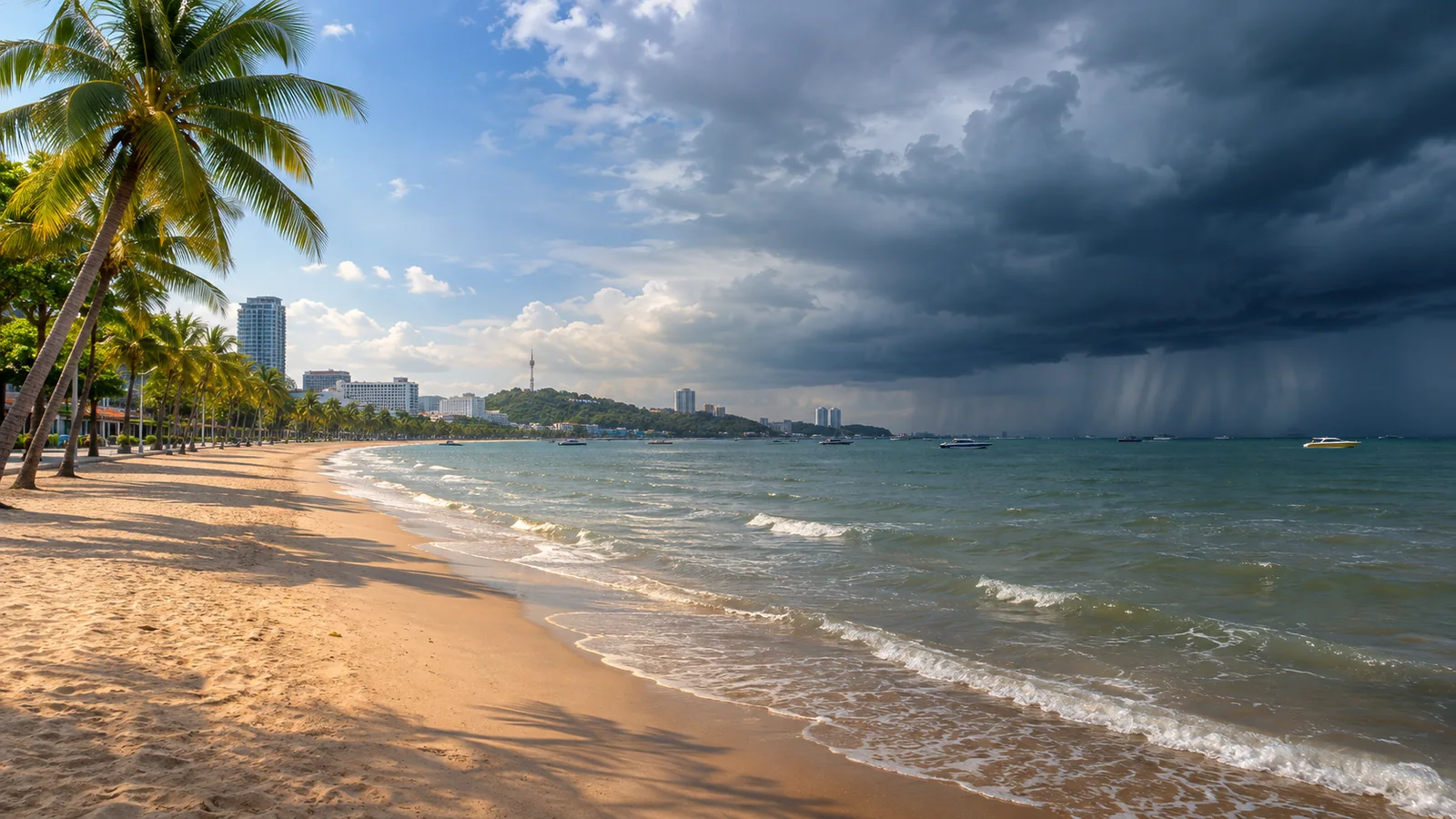
Quick answer: the best time to visit Pattaya is December to February. It is the driest and least humid part of the year, with about 12 to 20 mm of rain a month and highs around 30 to 31 °C. It is also high season, so hotels cost the most. If you want lower prices and can live with afternoon storms, May to October is cheaper; September and October are the wettest months. March and April are dry but the hottest.
Pattaya is warm all year. The daily high never drops much below 30 °C, so “best” here is about rain, humidity and crowds rather than temperature.
The three seasons
The Thai Meteorological Department splits the year into three seasons. The dates shift by a week or two from year to year.
| Season | Months (approx.) | What it means in Pattaya |
|---|---|---|
| Cool / dry season | mid-October to mid-February | Lowest humidity, least rain, coolest nights (around 23 °C). Peak tourist months. |
| Hot season | mid-February to mid-May | Still mostly dry, but April is the hottest month, with an average high of 33 °C. Songkran falls in April. |
| Rainy season | mid-May to mid-October | Rain on 11 to 17 days a month, with frequent showers and some thunderstorms. Fewer visitors, lower hotel rates. |
“Cool” is relative. December, the coolest month, still averages 30.2 °C in the afternoon.
Pattaya weather by month
The temperature, rain and rainy-day figures below are the Thai Meteorological Department’s official 30-year averages (1991–2020) for its Phatthaya weather station. Sea temperatures come from Weather2Travel.
| Month | Avg high | Avg low | Rain | Rainy days | Sea | Notes |
|---|---|---|---|---|---|---|
| January | 30.6 °C | 23.5 °C | 16 mm | 2.5 | 27 °C | Dry, most sunshine of the year. High season. |
| February | 31.2 °C | 24.5 °C | 20 mm | 2.5 | 28 °C | Dry. Crowds start to thin late in the month. |
| March | 32.0 °C | 25.5 °C | 47 mm | 4.8 | 29 °C | Getting hotter, still mostly dry. |
| April | 33.0 °C | 26.4 °C | 68 mm | 6.3 | 30 °C | Hottest month. Songkran. |
| May | 32.7 °C | 26.6 °C | 121 mm | 11.0 | 30 °C | Rainy season starts. Low season. |
| June | 32.0 °C | 26.4 °C | 132 mm | 12.6 | 30 °C | Showers most days, often in the afternoon. |
| July | 31.6 °C | 26.2 °C | 104 mm | 12.7 | 29 °C | Similar to June. |
| August | 31.4 °C | 26.1 °C | 91 mm | 12.9 | 29 °C | Similar to June. With September, the least sunny month. |
| September | 31.1 °C | 25.4 °C | 214 mm | 16.3 | 29 °C | One of the two wettest months. |
| October | 30.9 °C | 24.7 °C | 225 mm | 17.0 | 29 °C | Wettest month, most humid (83 %). Dries out late in the month. |
| November | 30.8 °C | 24.3 °C | 57 mm | 5.6 | 29 °C | Rain drops off sharply. High season begins. |
| December | 30.2 °C | 23.3 °C | 12 mm | 1.9 | 28 °C | Driest month. Busiest and most expensive. |
Across the year Pattaya gets about 1,106 mm of rain on about 106 days. Other climate sites give higher figures for some months: Weather2Travel, for example, lists 259 mm for September and 247 mm for October. Different stations and periods explain the gap. The pattern is the same everywhere: December to February is dry, and September and October are the wettest.
Sunshine follows the rain. The station records about 236 hours of sun in January and about 120 hours in August and September, roughly half as much.
High season, low season and hotel prices
The tourist calendar runs slightly differently from the weather calendar. Pattaya Mail describes high season as November to April and low season as May to October.
- High season (November to April): most visitors, fullest hotels, highest room rates. Prices are highest around Christmas and New Year. Book early for December and for the event weekends listed below.
- Low season (May to October): fewer tourists and lower room rates. Pattaya Mail reports that luxury and beachfront hotels often discount by 20 to 50 % in low season, and budget hotels and guesthouses also cut prices. Food and local transport cost about the same all year; a baht bus ride is 15 THB in any month.
- The trade-off: in low season some island trips, diving and parasailing run less often or are cancelled when the sea is rough.
If you want good weather without peak prices, early November (after the rains, before the December rush) and late February to March (still dry, fewer crowds) are the usual compromise.
For where to base yourself once you have picked your dates, see where to stay in Pattaya.
Events by month
Some of the busiest weeks of the year are set by festivals, not weather. Expect higher hotel prices and closed roads around these dates.
| When | Event | Our guide |
|---|---|---|
| Mid-April | Songkran, the Thai New Year water festival. Pattaya celebrates longer than most of Thailand, with its biggest day (Wan Lai) later in the week. | Songkran in Pattaya |
| Late November (24 November in 2026) | Loy Krathong, the full-moon festival with floating krathongs. | Loy Krathong in Pattaya 2026 |
| Late November (27–28 November in 2026) | Pattaya International Fireworks Festival on Pattaya Beach. | Pattaya Fireworks Festival 2026 |
| Early December (3–7 December in 2026) | Wonderfruit music and arts festival near Pattaya. | Wonderfruit 2026 |
| Mid-December (11–13 December 2026) | Tomorrowland Thailand at Wisdom Valley. | Tomorrowland Thailand 2026 |
| Late December | Christmas and New Year, the most expensive weeks for hotels. | Christmas and New Year in Pattaya |
In 2026 the five weeks from Loy Krathong to New Year are unusually packed, with Wonderfruit and Tomorrowland back to back in December. If you are coming for one of them, book your room first.
Month by month: who should go when
- December to February: best for a beach holiday, island trips and first-time visitors. Pay high-season prices and book ahead.
- March and April: dry and very hot. Good if you want Songkran, or the end of high season with fewer people. Plan beach time for the morning.
- May to August: low season, with rain on 11 to 13 days a month in the official averages, so more than half the days stay dry. Good for lower hotel rates and quieter streets.
- September and October: the wettest stretch and the cheapest. Fine for nightlife, food and spa trips; less reliable for boat trips.
- November: the rains ease, the high season starts, and in 2026 the festival season begins with Loy Krathong and the fireworks.
How many days is enough?
For a first visit, three to four nights covers the main areas: a beach day, an evening on Walking Street, a viewpoint or temple, and a day trip to Koh Larn. Our first-time guide to Pattaya has a starting plan.
Add time for side trips:
- Koh Larn: a day trip from Bali Hai pier. See our Koh Larn guide.
- Koh Samet: possible as a long day by car, better with one night. See Pattaya to Koh Samet.
- Koh Chang: a full travel day each way, so plan at least two nights. See Pattaya to Koh Chang.
- Festivals: add a day on each side of the event, as roads close and transport gets busy.
A week gives you Pattaya plus one island at an easy pace.
Where these numbers come from
Checked in November 2026:
- Thai Meteorological Department, Climatological Data for the Period 1991–2020, Phatthaya station (index 48461): monthly mean maximum and minimum temperature, rainfall, rainy days, humidity and sunshine hours.
- Thai Meteorological Department, description of Thailand’s seasons (summer from about mid-February to mid-May, rainy season mid-May to mid-October, winter mid-October to mid-February).
- Weather2Travel, Pattaya climate page: average sea temperature by month, and its own monthly rainfall figures used for comparison.
- Pattaya Mail, “Is it really cheaper to travel and live in Pattaya during low season?” (February 2025): high and low season months, low-season hotel discounts of 20 to 50 %.
- Event dates come from our own event guides linked above, each with its own sources and check date. The Tomorrowland Thailand 2026 dates are 11–13 December.
Climate averages describe a typical year, not a forecast. Check a current forecast a few days before you travel.
Pattaya.love Editorial Team
Local Experts since 2019
Our team of Pattaya-based writers, photographers, and long-term residents researches every guide on the ground. We visit venues, test routes, and verify every recommendation so you get actionable, up-to-date information you can trust.